
GOVERNMENT POLYTECHNIC
KALAMASSERY, KERALA STATE, SOUTH INDIA
PIN-683 104
INTRODUCTION
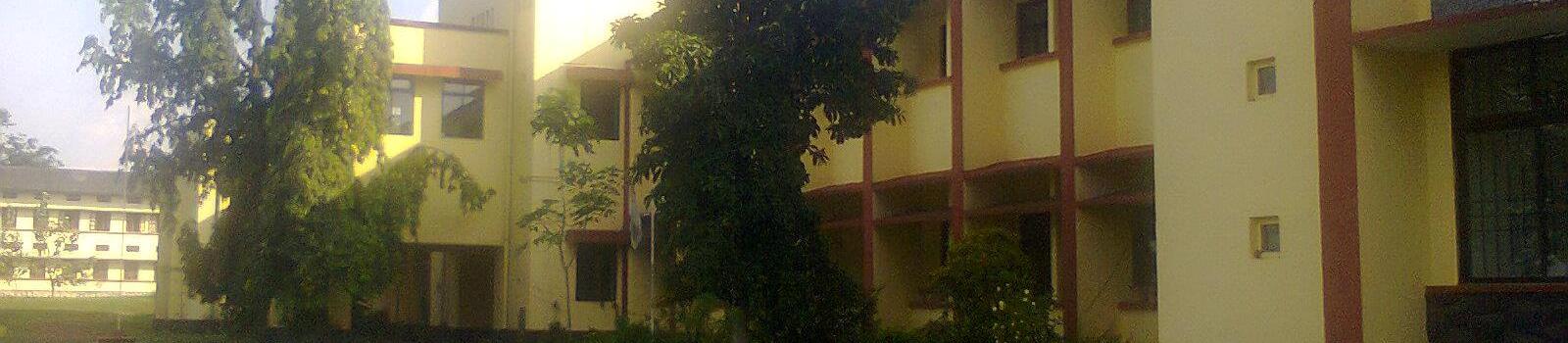
The Government Polytechnic, Kalamassery is one of the major Polytechnics in Kerala State. It was established in the year 1951 during the first five year plan. This institution is located by the side of NH 47, almost midway between Ernakulam and Alwaye and in the industrial belt of Kerala. The campus of this polytechnic has an area of 16 hectares with entrance from the National Highway. Within the campus there are a number of buildings like the administrative block, classrooms, workshops, laboratories, student’s hostel, staff quarters, canteen etc., all located in such a manner that it provides a calm and quiet atmosphere for teaching and learning unaffected by the sound and fury of this industrial town. The Cochin Harbour, popularly known as the ‘Queen of the Arabian Sea’, Cochin Airport, Naval Base, Railway Stations and K.S.R.T.C. Bus Stations at Ernakulam and Alwaye lie within a radius of 20 K.M. from this institution and they are all well connected with a network of roads. The major industrial establishments and institutions such as the FACT, HMT, Premier Tyres, I.A.C., N.A.D., Cochin Oil Refinery, Cochin Shipyard, Cochin University of Science and Technology, NPOL, Model Engineering College, etc. are situated at short distances from this Polytechnic.
Some of the most important institutions such as the Technical Teachers Training Institute (Extension Centre), Curriculum Development Centre (under the World Bank Project), Lal Bahadur Shastri Centre for Science and Technology, Supervisory Development Centre, Women’s Polytechnic, Govt. Industrial Training Institute, Productivity Council, Food Craft Institute are all situated in the vicinity of this institution, making their own contribution to the growth and development of this polytechnic. The training Centre of Nirmithi Kendra is also expected to be established within the polytechnic campus, in the near future.
The Institution was originally started in the erstwhile Cochin State so as to impart technician training in four disciplines namely Fisheries Technology, Food Technology, Chemical Engineering and Automobile Engineering. The Institution was upgraded as a Polytechnic in the year 1957 under the department of Technical Education. Three Diploma courses in Engineering viz. Civil, Mechanical and Electrical branches were then introduced. Courses in Fisheries Technology and Food Technology were later abolished. With the advent of the era of specialisation, Post Diploma course in Refrigeration and Air Conditioning Engineering was started in 1978. Also, to keep pace with the modern trends, a regular three year Diploma Course in Computer Engineering was started in 1985. There is also a Post Diploma Course in Computer Aided Design since 1990, under the World Bank Scheme. In addition to regular Diploma courses in six branches of Engineering, four year part-time Diploma Courses are also offered in Civil, Mechanical and Electrical Engineering. This provides opportunities for the technical staff employed in the nearby industries and government departments to improve their qualifications and career prospects.
II. PAST IN PERSPECTIVE
The idea of starting a Polytechnic at Cochin was germinated in the minds of Shri. K. G. Menon, the then Chief Secretary of Travancore-Cochin State. With visionary zeal and missionary spirit a person none other than Pareekshit Thampuran, the scholar Maharaja of Cochin came forward and inaugurated the institute on July 15, 1951, at a function brightened with the presence of such stalwarts in public life such as M/s A. J. John, T. K. Narayana Pillai and C. Kesavan, the then ministers of the Travancore Cochin State.
The locale for this institute, which later became the breeding ground for a well trained army of technologists who formed the vanguard in the State’s march towards industrialisation was once the barracks of the Travancore State Forces - a 59 Acre plot in the suburban, Kalamassery.
The Polytechnic brought with it many novelties to the forsaken village of Kalamassery. It was the first building at Kalamassery to be electrified and connected with supply of protected water. The bi-weekly dispensary attached to the polytechnic was the only source of medical aid to the natives who inhabited a difficult terrain infested with poisonous snakes.
The detractors of Kalamassery very valiantly fought a losing battle to shift the location of the new institute to some other place, if possible outside Cochin. The main plank of their criticism was that it was a God forsaken place. The answer to this criticism was provided by Sir. Ramaswamy Mudaliyar, the then Vice-Chancellor of the University of Travancore; who twice visited the institute. He remarked: “Kalamassery is definitely not a God forsaken place, but only a man forsaken place.” How prophetic his words proved to be!
Now the contours of its landscape present a different picture. The eastern skyline is filled with the towering structure of the Hindustan Machine Tools, on the southern flank is the sprawling campus of the Cochin University, and on the Northern side is the Premier Tyres. And through the columns of dark fume which fill the western horizon one could hear the distant thunder of modern Kerala - the industrious and industrialised Kerala presented in miniature at Udyogamandal.
Sliding through the chequered history of this Polytechnic, its vicissitudes present an unbroken record of dedicated service to the cause of Technical Education in the state. Launched as a Government institution, it changed hands many times. Soon after the inception it was handed over to the then University of Travancore, but was returned to the Government itself in 1957. Later in the wake of reorganisation of Technical Education in the State, it came under the Director of Technical Education.
The Kalamassery Govt. Polytechnic was the second Polytechnic in the State, the first one being the Maharajah’s Technological Institute at Trissur. Shri. M. Vasanda Rao, the then Principal of Maharajah’s Technological Institute, Trissur was transferred to Kalamassery to take charge as special officer of the new Institute. His designation was later changed to Principal.
The Kalamassery Polytechnic started with facilities for imparting instruction in Automobile Engineering, Chemical Engineering, Fisheries Technology and Food Technology —all three year courses. Later the course of Chemical Engineering was transferred to Kerala Govt. Polytechnic, Calicut and other courses except the one in Automobile Engineering were dropped in 1957-58. But new courses in Civil, Mechanical and Electrical Engineering were introduced in the same year. Part-time Diploma courses in Civil, Mechanical and Electrical Engineering were started in 1964.
The Polytechnic moved into its permanent Building at the beginning of the academic year 1960-61.
OTHER RELATED INFORMATION
Over and above the courses already being offered, a three year regular Diploma Course in Electronics Production Technology has been sanctioned under the World Bank Scheme to be conducted in this institution from 1992-’93.
This institution has been selected as the only Polytechnic in Kerala State for the implementation of the Electronics Industry Development (Man power component) project by the Department of Electronics (DoE), Govt. of India. This project known as IMPACT will provide all the infrastructural facilities for the running of the new course. The expenditure for this project is met by the Swiss Co-operation and the World Bank as the project is sponsored by DoE. A total of over Rs. 74 lakhs will be spent by the project towards grant-in-aid.
Also the Government Polytechnic, Kalamassery, has been identified by the Government of India to be developed into a community Polytechnic from 1992-1993.
OPENING OF POLYTECHNIC INSTITUTE
COCHIN MAHARAJA AT KALAMASSERY
The Polytechnic Institute at Kalamassery, which would provide courses in 1) Automobile Engineering, 2) Chemical Technology, 3) Food Technology and 4) Fisheries Technology, and which would train up young men for the industrialisation of the state, was formally opened last Sunday afternoon at Kalamassery by H. H. the Maharaja of Cochin, before a distinguished gathering that had collected there from all over the Malabar Coast and adjoining areas, including a number of industrialists from Coimbatore.
Situated in an expansive area of 62 acres, and with several buildings equipped with fresh water and electric supplies, the Institute is ideally placed by the side of the Alwaye River and adjoining the railway route.
Mr. C. Kesavan, Chief Minister, welcomed the distinguished gathering and traced the history of the Institute. He hoped that it will turn out to be a land-mark in the state’s industrial march.
In opening the institute, His Highness the Maharaja emphasised that, confronted as we are with a position of “produce or perish”, it has become necessary on the part of the state, in the light of its pace of industrialisation, “to impart to the education a technical bias so that we may be able to provide the necessary number of specialists to our own industries”, and he hoped that the Polytechnic Institute would be an answer to that demand. Paying a tribute to the Chief Secretary, Mr. K. G. Menon, for conceiving and planning the Institute, His Highness announced that he was endowing a sum of Rs. 1000/–, with the interest of which a prize could be given every year to the best student in any of the sections of the Institute.
Mr. T. K. Narayanan Pillai, the Education Minister, thanked His Highness as also others who had contributed to make the coming into shape of the institution so soon. He made special mention of Shri. Govindarajulu’s service to the Institute, and the endowment he had made to the institution.
The above report was published in the oldest English weekly in the state, Malabar Herald, published from Fort Cochin.